
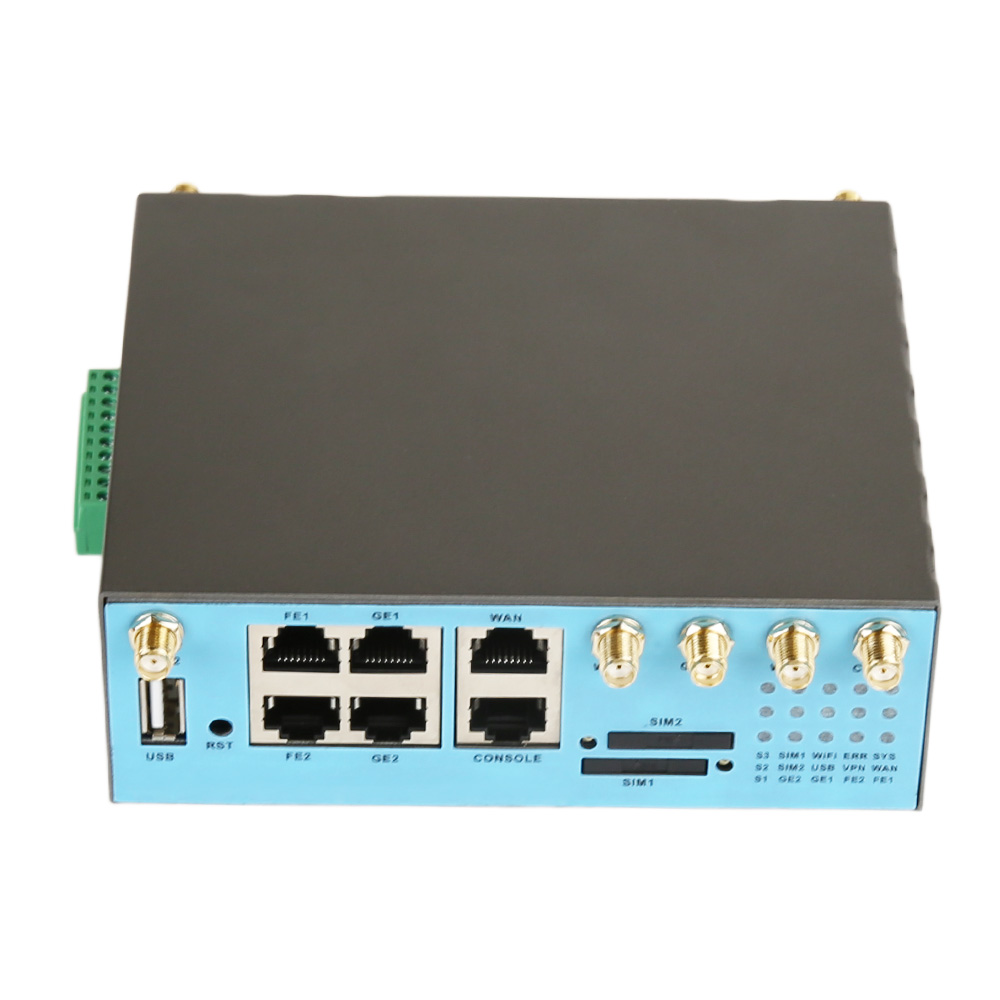
Gigabit 5G PoE Router for Smart Parking: Connecting Entry Lanes, Pay Stations, Guidance Systems, EV Chargers and Cameras in Surface and Underground Car Parks
E-Lins offers the H820QOf outdoor 5G CPE with 5G SA/NSA, 4G fallback, and two Gigabit Ethernet ports.
A modern car park is a small network of its own. Cameras read number plates at the entrance, barriers open and close, pay stations take cards and mobile payments, guidance signs count free spaces, chargers report to an energy platform, and security cameras record every level. All of it has to reach a central management system, often operated by a company that runs dozens of car parks in different cities and wants each one online from the day it opens.
A gigabit 5G PoE router is increasingly the core of that network. This article explains why each of those three words matters in a car park, walks through the main zones and their devices, addresses the special problem of underground signal, and shows how E-Lins products fit.
Why “Gigabit”, “5G” and “PoE” All Matter
Gigabit: traffic inside the car park, between cameras, recorders, switches and controllers, can far exceed what crosses the cellular link. Fast Ethernet ports become bottlenecks when several cameras feed a recorder through the router.
5G: car parks are often opened, refurbished or re-equipped faster than a fixed line can be installed, and 5G gives enough capacity for event video, remote viewing and management traffic.
PoE: cameras, intercoms, access points and some signs are mounted on ceilings and walls far from sockets, and PoE delivers their power over the same cable as their data.
Zone by Zone
Entry and exit lanes
Plate-reading cameras, barrier controllers, ticket machines and intercoms. Cameras and intercoms are usually PoE devices on Ethernet. Barrier controllers may offer dry contacts or serial interfaces. Response time matters: a driver waiting at a barrier notices every second.
Pay stations
Payment terminals and pay-on-foot machines handle card data, so payment industry security practice favours keeping their traffic separate from cameras, guidance systems and public Wi-Fi. A dedicated network segment, protected by firewall rules and a VPN to the payment back office, simplifies security reviews.
Guidance and occupancy
Bay sensors and indicators report occupancy to zone controllers, which drive the signs at each level and at the entrance. Zone controllers commonly connect over Ethernet or RS485. Data volumes are small, but the system must be reliable, since drivers rely on the signs.
EV charging bays
Chargers communicate with a charging management platform, often using the Open Charge Point Protocol (OCPP) over the internet. They need reliable connectivity for authorisation and billing, and a charger offline is a charger that cannot be paid for.
Security cameras
Cameras on each level record to a local recorder, with remote viewing and event upload. This is the zone that drives gigabit and PoE requirements most strongly.
|
Zone |
Typical devices |
Interfaces |
Network need |
|
Entry and exit |
Plate cameras, barriers, intercoms |
Ethernet, PoE, contacts, serial |
Low latency, reliable |
|
Pay stations |
Payment terminals |
Ethernet |
Isolated, secure |
|
Guidance |
Zone controllers, signs |
Ethernet, RS485 |
Small data, reliable |
|
EV charging |
Chargers |
Ethernet or cellular |
Reliable, always online |
|
Security |
Cameras, recorder |
Ethernet, PoE |
High local traffic, event upload |
The Underground Problem
Reinforced concrete blocks radio signals, and lower levels of an underground car park may have no usable cellular coverage at all. Placing the router where the equipment is often means placing it where the signal is not.
Antennas at the surface or ramp: run low-loss antenna cables from the router to antennas at ground level or at the entrance ramp, keeping cable runs as short as practical.
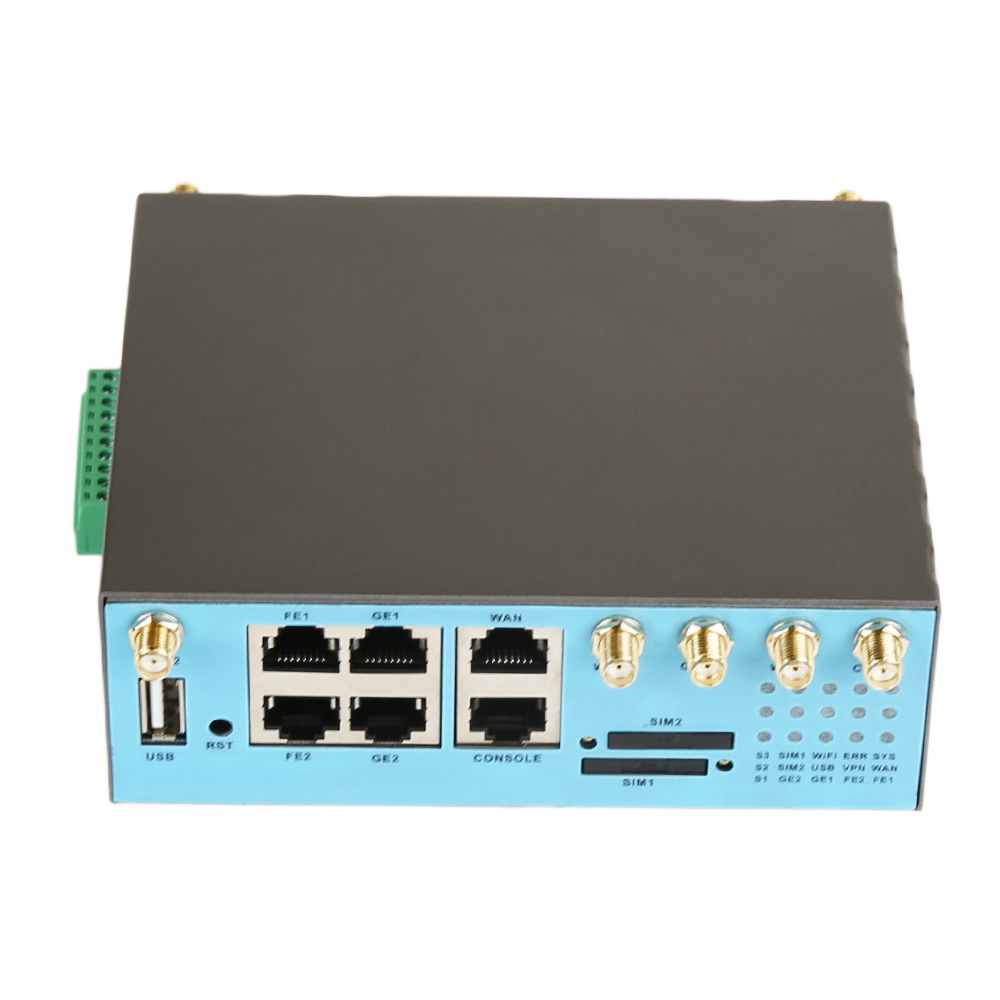
An outdoor CPE at street level: mount an outdoor 5G CPE where the signal is strong and run Ethernet down to the router and switches inside the car park. E-Lins offers the H820QOf outdoor 5G CPE with 5G SA/NSA, 4G fallback, and two Gigabit Ethernet ports.
Survey first: measure each operator’s signal at candidate antenna positions before choosing, and consider dual SIM where coverage from any one operator is marginal.
Segmentation and Security
Separate the car park’s systems into segments, such as payment, operations, cameras, and public Wi-Fi, with firewall rules that allow only the traffic each segment needs. Send operational and payment traffic to the back office through VPN tunnels, and expose nothing on the cellular interface. E-Lins routers include a stateful firewall and support WireGuard, IPsec and OpenVPN, with L2TP, GRE and DMVPN listed across the range; E-Lins PoE switches such as the EL900-AF-82GN support VLANs for segmentation on the local side.
Matching E-Lins Products to Car Park Sizes
Small surface car park
One entry lane, one pay station, and two or three cameras. A router such as the H820frc RedCap model, with five Gigabit Ethernet ports and a PoE Out variant, can power cameras directly and connect the pay station and barrier controller, where 5G standalone coverage is available.
Multi-level car park
Several lanes, many cameras across levels, guidance and pay-on-foot machines. The H900f provides 5G SA/NSA, three Gigabit and two Fast Ethernet ports, dual SIM hot backup with switchover in seconds, a serial port for a guidance or barrier controller, four DI/DO for barrier status and cabinet alarms, and PoE In and Out. A PoE switch such as the EL900-AF-82GN, with ten ports, a 1000M uplink, 802.3af/at support and a listed 400 W power figure, supplies the cameras on each level.
Kiosk or pay-on-foot machine with its own link
Where a payment kiosk is far from the main cabinet, a compact router such as the H685f, with 5G SA/NSA, PoE In, and a super-mini format, can sit inside the kiosk.
Power and Cabinet Placement
Place the router in the main equipment cabinet, close to the switch that feeds the cameras and lanes, and give it the same protected supply as the barrier controllers and payment equipment. A small UPS keeps barriers, payment, and connectivity working through short power cuts. Cabinets near ramps and entrances can be cold and damp in winter and warm in summer, so industrial temperature ratings matter even under a roof. E-Lins routers commonly accept 5 to 40V DC, with a 5 to 60V DC option, through dual power inputs with automatic failover.
A Familiar Precedent
Connecting payment machines over cellular is not new. E-Lins financial solutions connect ATMs to bank central systems over public wireless networks instead of leased lines, including portable ATMs at events, concerts and shopping centres. The same principles of secure tunnels, reliable links and remote management apply to car park payment systems.
Operating Many Car Parks
Operators with many sites need every router managed centrally. E-Lins routers support TR-069, SNMP and SSH and work with the E-Lins NMS cloud platform for status monitoring, parameter management, remote firmware upgrades and statistics. Standard configuration templates, with the same segment and firewall design at every site, make each new car park a repeat of the last one.
The Manufacturer
Shenzhen E-Lins Technology Co., Ltd. has supplied industrial cellular routers since its industrial roots in 1999 and released 5G NR industrial routers from 2019. Its equipment is specified with components rated from -35°C to +75°C, 15KV ESD protection, and 1.5KV electromagnetic isolation, and is supported by 7×24 remote technical support. For smart parking, choose a gigabit 5G PoE router that matches each zone’s devices, solves the signal problem first, keeps payment traffic separate, and ensures the car park’s network will work as smoothly as its barriers.
Related products
-
-
Industrial 4G Router OEM Manufacturer in China: Six Approval Gates That Keep a Private-Label Programme on Track Across Time Zones
Contact UsE-Lins develops its system software entirely in-house and lists firmware behaviour within its customisation scope, so defaults can be agreed in advance.
-
PLC Fiber Splitter ABS Box Type
Contact UsCompact PLC fiber splitter in an ABS box for reliable multi-channel optical signal distribution.
-

Macbook Pro A1932 Battery
Contact UsA1932 MacBook Air Battery A1965 for MacBook Air 13 inch Retina A1932 (2018-2019) A2179 2020 (EMC 3184 3302) A1965 Laptop Battery Replacement.
Please contact with us by email directly to get extra coupon.

Reviews
There are no reviews yet.